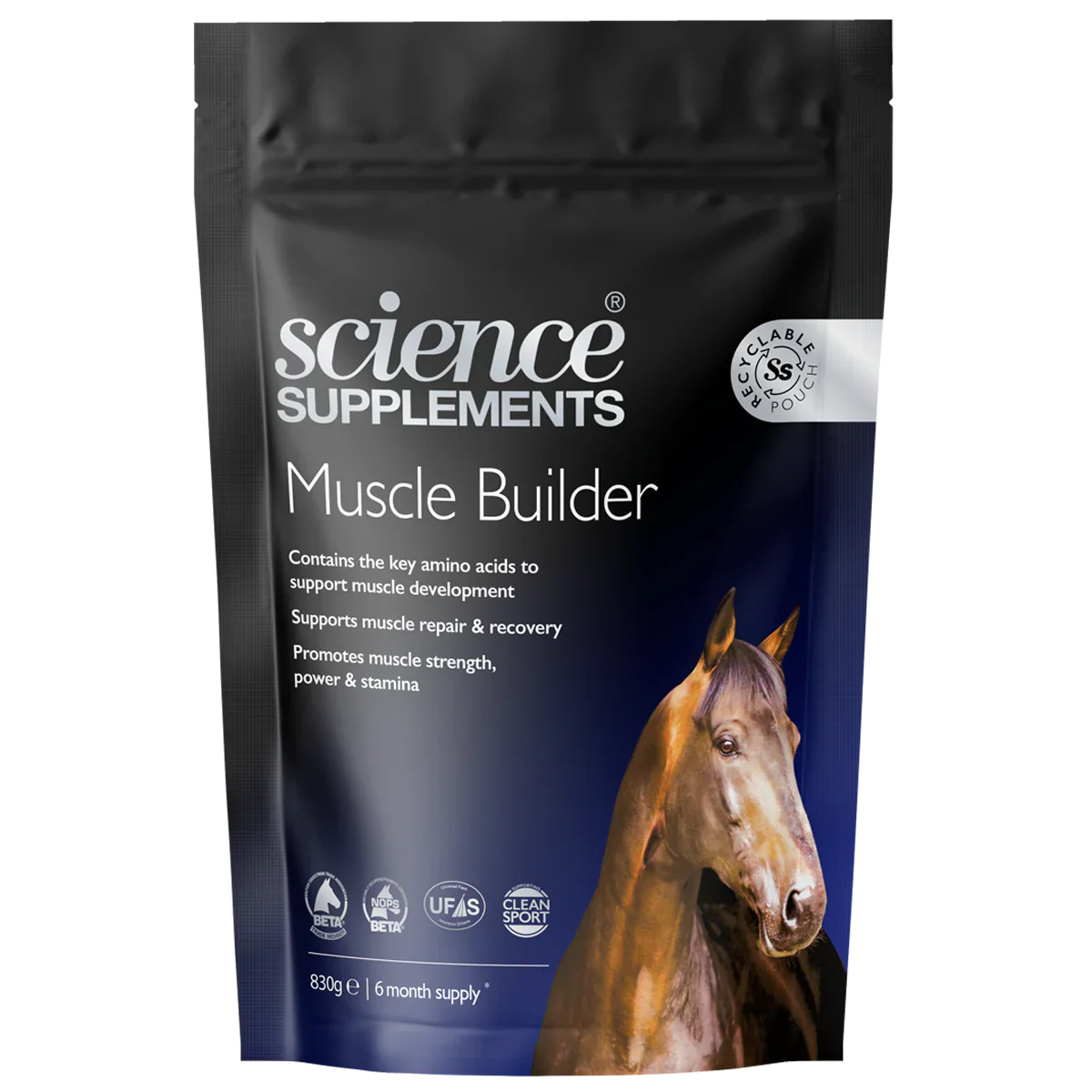
Science Supplements MuscleAid
MuscleAid is a specialist formulation that reduces the incidence of exercise induced muscle damage and soreness and to accelerate recovery.
Many horses suffer with muscle problems, either as a result of dietary sensitivities, genetic predisposition, anatomical asymmetries, sub-optimal conformation or simply the demands of training and competition.
Muscular pain can lead to significant days lost from training and reduced performance. It has been recognised that for horses at higher risk of muscle problems, providing dietary support is an essential part of long-term management.
What’s in it?
Natural antioxidants (Vitamin E and Selenium) support muscle cell integrity and reduce free radical damage.
Astaxanthin is a potent anti-oxidant which is found in yeast, algae, and wild salmon (it gives salmon it’s pink colour). Astaxanthin has been studied in horses in combination with L-Carnitine. This combination was fed to horses in training. The result was reduced muscle damage. Astaxanthin should be fed at a minimum dose of 37.5mg in combination with L-Carnitine to prevent muscle damage to horses in training.
L-Carnitine is a naturally occurring derivative of the amino acid Lysine. L-Carnitine is involved in energy and metabolism. The combination of L-Carnitine and Astaxanthin have been shown to reduce muscle damage which results from athletic training in horses. L-Carnitine should be fed at a minimum serving of 1.5g daily for a 500kg horse when used in combination with Astaxanthin to reduce muscle damage, or to improve the muscle’s response to training a serving of 10g per day can be used.
HMB (hydroxy methyl butyrate) A metabolite of the essential amino acid Leucine.
HMB has been studied in horses and has been found to result in decreased blood creatine kinase and lactic acid after exercise. These findings support the idea that HMB helps to reduce exercise induced muscle damage in horses.
MuscleAid is a specialist formulation that reduces the incidence of exercise induced muscle damage and soreness and to accelerate recovery.
Many horses suffer with muscle problems, either as a result of dietary sensitivities, genetic predisposition, anatomical asymmetries, sub-optimal conformation or simply the demands of training and competition.
Muscular pain can lead to significant days lost from training and reduced performance. It has been recognised that for horses at higher risk of muscle problems, providing dietary support is an essential part of long-term management.
What’s in it?
Natural antioxidants (Vitamin E and Selenium) support muscle cell integrity and reduce free radical damage.
Astaxanthin is a potent anti-oxidant which is found in yeast, algae, and wild salmon (it gives salmon it’s pink colour). Astaxanthin has been studied in horses in combination with L-Carnitine. This combination was fed to horses in training. The result was reduced muscle damage. Astaxanthin should be fed at a minimum dose of 37.5mg in combination with L-Carnitine to prevent muscle damage to horses in training.
L-Carnitine is a naturally occurring derivative of the amino acid Lysine. L-Carnitine is involved in energy and metabolism. The combination of L-Carnitine and Astaxanthin have been shown to reduce muscle damage which results from athletic training in horses. L-Carnitine should be fed at a minimum serving of 1.5g daily for a 500kg horse when used in combination with Astaxanthin to reduce muscle damage, or to improve the muscle’s response to training a serving of 10g per day can be used.
HMB (hydroxy methyl butyrate) A metabolite of the essential amino acid Leucine.
HMB has been studied in horses and has been found to result in decreased blood creatine kinase and lactic acid after exercise. These findings support the idea that HMB helps to reduce exercise induced muscle damage in horses.
Original: $37.50
-70%$37.50
$11.25Description
MuscleAid is a specialist formulation that reduces the incidence of exercise induced muscle damage and soreness and to accelerate recovery.
Many horses suffer with muscle problems, either as a result of dietary sensitivities, genetic predisposition, anatomical asymmetries, sub-optimal conformation or simply the demands of training and competition.
Muscular pain can lead to significant days lost from training and reduced performance. It has been recognised that for horses at higher risk of muscle problems, providing dietary support is an essential part of long-term management.
What’s in it?
Natural antioxidants (Vitamin E and Selenium) support muscle cell integrity and reduce free radical damage.
Astaxanthin is a potent anti-oxidant which is found in yeast, algae, and wild salmon (it gives salmon it’s pink colour). Astaxanthin has been studied in horses in combination with L-Carnitine. This combination was fed to horses in training. The result was reduced muscle damage. Astaxanthin should be fed at a minimum dose of 37.5mg in combination with L-Carnitine to prevent muscle damage to horses in training.
L-Carnitine is a naturally occurring derivative of the amino acid Lysine. L-Carnitine is involved in energy and metabolism. The combination of L-Carnitine and Astaxanthin have been shown to reduce muscle damage which results from athletic training in horses. L-Carnitine should be fed at a minimum serving of 1.5g daily for a 500kg horse when used in combination with Astaxanthin to reduce muscle damage, or to improve the muscle’s response to training a serving of 10g per day can be used.
HMB (hydroxy methyl butyrate) A metabolite of the essential amino acid Leucine.
HMB has been studied in horses and has been found to result in decreased blood creatine kinase and lactic acid after exercise. These findings support the idea that HMB helps to reduce exercise induced muscle damage in horses.